Is a Handleless Kitchen Worth It? Key Insights for 2026
Handleless kitchens are rapidly gaining popularity, now making up one in three installations. They come in three types, Gola profiles, push-to-open, and true handleless, each with different usability and cost implications. While they offer a sleek, modern look, they require premium hardware and careful planning. Factors like cooking habits, children, kitchen size, and maintenance play a crucial role. For many homes, Gola works best, while push-to-open suits low-usage spaces. If chosen thoughtfully, handleless kitchens deliver style and efficiency; otherwise, conventional designs remain more practical and cost-effective.
Of every 100 kitchens we deliver at Chattels Design, the share built as fully handle less has gone from one in twenty five years ago to roughly one in three today. The shift is real, and it has now spread from luxury Banjara Hills apartments and Whitefield villas into mid-premium 3 BHKs across Bangalore and Hyderabad
If you’re considering a handle less kitchen, the marketing material online tends to leave out the parts that actually matter: which mechanism suits your daily use, what the hardware actually costs, where alignment goes wrong, and where this style genuinely doesn’t make sense. What follows is an honest breakdown from a team that has installed several hundred of them across Bengaluru and Hyderabad.
What “handleless” actually means (it’s not one thing)
Three distinct mechanisms get sold under the same word. They look similar in marketing photographs and feel very different in daily use.
Profile handles (Gola, J-Pull, L-Profile, C-Profile)
A continuous aluminium or stainless-steel profile is recessed into the shutter — usually horizontally between rows of cabinets, sometimes vertically along an edge. You hook your fingers behind the profile to open. The Italian term Gola has become the catch-all in the Indian market.
This is the most common handleless style we install. The profile colour can match shutters (silver, black, champagne, brass). It works with virtually every shutter material — laminate, acrylic, lacquered glass, PU.
Cost premium over a conventional handle kitchen: roughly 8–15%, depending on whether you use horizontal Gola only (more affordable) or full vertical-and-horizontal profiles (premium).
Push-to-open (TipOn, touch latch)

A small mechanical or magnetic latch behind the shutter releases when you press the front. No visible profile, no groove, no gap. The cleanest look of the three.
The catch: every time you open a cabinet, you press the shutter face. On matte black PU or dark high-gloss laminate, fingerprints become a visible problem within weeks. We almost always pair push-to-open with anti-fingerprint laminates (Greenlam Innofin, Merino MarkerOne) or matte acrylic to manage this.
The mechanism itself is reliable — Blum’s TipOn and Hettich’s Easy 2.0 will both clock 80,000+ open-close cycles. What fails is usually alignment after a year, which a 15-minute service visit fixes.
Cost premium: 12–25% over conventional, because you need to spec better hardware to make this work cleanly.
True handleless (recessed rail)
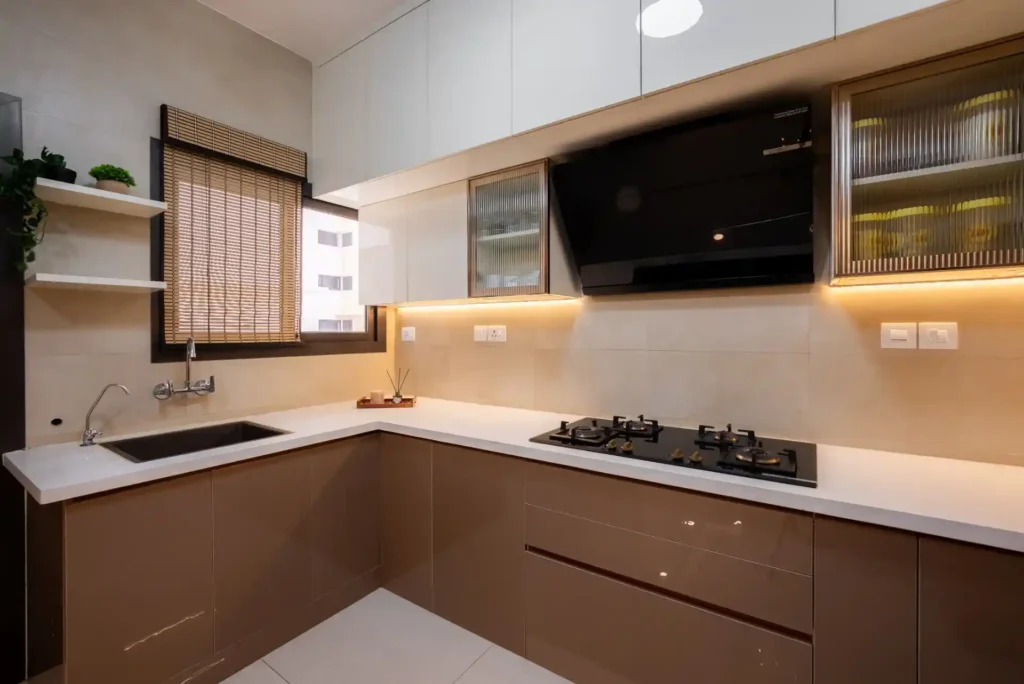
A metal rail is fitted behind the shutter, with a small finger gap between two cabinet rows. From the front, you see one continuous shutter face. The cleanest, most expensive mechanism.
We install this only in premium projects — most often in Whitefield villas and 4 BHK apartments in Hyderabad’s Banjara Hills and Jubilee Hills. Two reasons: the cost premium (25–40%), and the fact that retrofitting it later is essentially impossible. You commit at the design stage.
The hardware brands that actually matter
Three brands dominate quality handleless installations in India: Hettich (German, very common in our spec sheets), Hafele (German, slightly higher end), and Blum (Austrian, premium).
For a handleless kitchen specifically, here’s what we spec:
• Hinges — Hettich Sensys 8645 with built-in soft-close, or Blum Clip Top BLUMOTION. Skip cheap unbranded hinges. They sag within 18 months and ruin shutter alignment, which is fatal in a handleless design where the shutter face is its own visual signature.
• Drawers — Hettich AvanTech YOU or Blum LegraBox for premium projects; Hettich InnoTech Atira for value-conscious ones. All three have integrated soft-close.
• Lift-ups (for tall units) — Blum Aventos HK or Hafele Free Up. These are not optional luxuries in handleless designs — without them, you would need handles on the upper shutters, defeating the point.
• Profiles — for Gola kitchens, we typically spec Lloyd’s, Indaux, or Hettich Cargo profiles. Avoid generic Chinese-import profiles. They are 30–40% cheaper, but the powder-coating chips are within two years.
Where handleless kitchens actually disappoint
Across 3,000+ kitchens delivered, the patterns of regret are predictable.
Households with young children. Push-to-open shutters open with knee bumps, foot kicks, dragged toys. We have logged repeat service requests within the first year for exactly this. The fix: spec handleless only above counter height, with conventional or J-pull on lower cabinets. Pure aesthetics-first decisions backfire here.
Heavy daily cooking households. When your hands are oily or wet, push-to-open works fine; Gola profiles do not (you need finger-grip, and a Gola groove fills with oil residue if not wiped). True handleless rails fall in between.
Gloss black, gloss white, navy. All three show every fingerprint. We strongly recommend matte finishes or anti-fingerprint laminates for any handleless kitchen, regardless of mechanism.
Smaller kitchens (parallel layouts under 8 feet). The visual benefit of “uninterrupted lines” is real only when you have continuous cabinetry runs of 6+ feet. In a tight parallel kitchen, the price premium is rarely justified by the aesthetic gain.
Cost ranges we’re quoting in 2026
For a 10×10 ft modular kitchen (carcass + shutters + hardware + countertop, excluding appliances and electrical):
• Conventional handles, mid-range
• Gola / J-Pull handleless, mid-range
• Push-to-open handleless, premium
• True handleless, luxury (with PU shutters)
These are working ranges from our Bengaluru and Hyderabad projects. Actual quotes depend heavily on shutter material, hardware brand, and countertop choice (granite vs. quartz vs. lacquered glass vs. marble).
Bengaluru vs. Hyderabad: city patterns we observe
In Bengaluru, the strongest demand for handleless designs comes from villa projects in Whitefield and Sarjapur Road, and from larger 3–4 BHK apartments in HSR Layout and Hennur. The dominant style preference is matte (charcoal, taupe, sage), often combined with quartz countertops and PU lacquer.
In Hyderabad, demand skews further toward gloss and luxury — particularly in Banjara Hills, Jubilee Hills, and Manikonda. PU lacquer in deep tones with brass profile inlays is more common than in Bengaluru. Both cities are seeing rapid uptake of Japandi-style handleless kitchens in younger households.
Is handleless right for your kitchen?
Five honest questions to ask before you commit:
1. Do you cook daily, with messy or oily hands? If yes, pick Gola — not push-to-open.
2. Do you have children under 8? If yes, avoid push-to-open below counter height.
3. Are your cabinetry runs continuous (6+ ft)? If no, the visual gain is small.
4. Do you mind wiping down shutter faces frequently? If yes, you need anti-fingerprint finishes.
5. Are you willing to spec premium hardware? Handleless designs fail loudly with cheap hinges; they look spectacular with quality ones.
If your honest answers are yes-to-most, this style will reward you for years. If they aren’t, a well-designed conventional kitchen with quality handles will look better, last longer, and cost less.